Summary
This project explored a role-based approach to drone chassis design using additive manufacturing. The goal was to move away from modifying commercial drones for specific tasks and instead define the drone’s intended application first, then design a modular chassis around that use case. The design emphasized adaptability, low-cost fabrication, ease of modification, and replaceable parts.
Intro/Background
This project focuses on changing the way specialized drones are designed by starting with the drone’s intended role rather than modifying an existing commercial drone after the fact. Through the AED delivery drone example discussed during the semester, the project identified that many drone solutions are created by adapting commercial platforms to meet a specific need. While this approach can work, it may limit how well the drone performs in specialized applications.
This project instead proposes a modular drone chassis that can be scaled and adjusted depending on the use case. Additive manufacturing supports this design direction because it allows for rapid prototyping, easier customization, lower-cost fabrication, and simpler replacement of damaged components.
Drone innovation in the commercial sector has begun to slow, even though drone technology continues to expand in military and security applications. The initial motivation for this project came from ecological protection, specifically the possibility of using drones for pest control and viral contamination efforts involving wild boars and Chronic Wasting Disease.
As the project developed, additional industries were identified where drone technology could help address gaps in coverage or response capability. These included firefighting, medical device delivery, large-area search-and-rescue operations, and avalanche rescue. These applications require drones that can carry different sensors, cameras, medical devices, or rescue equipment, which supports the need for a flexible and purpose-built chassis design.
Impact
If successful, we hope to develop a modular base drone chassis that would enable quick modification and integration with multiple supporting technologies to improve effectiveness for specific use cases. As previously stated, modern drones are often externally modified to support specialized applications. We hope to move the manufacturing design process back to the CAD stage and allow overall drone development to reflect its intended application from the beginning. This would shift the design philosophy away from modifying existing drones for specialized use and toward designing drones specifically for their intended purpose.
Methods/Approach
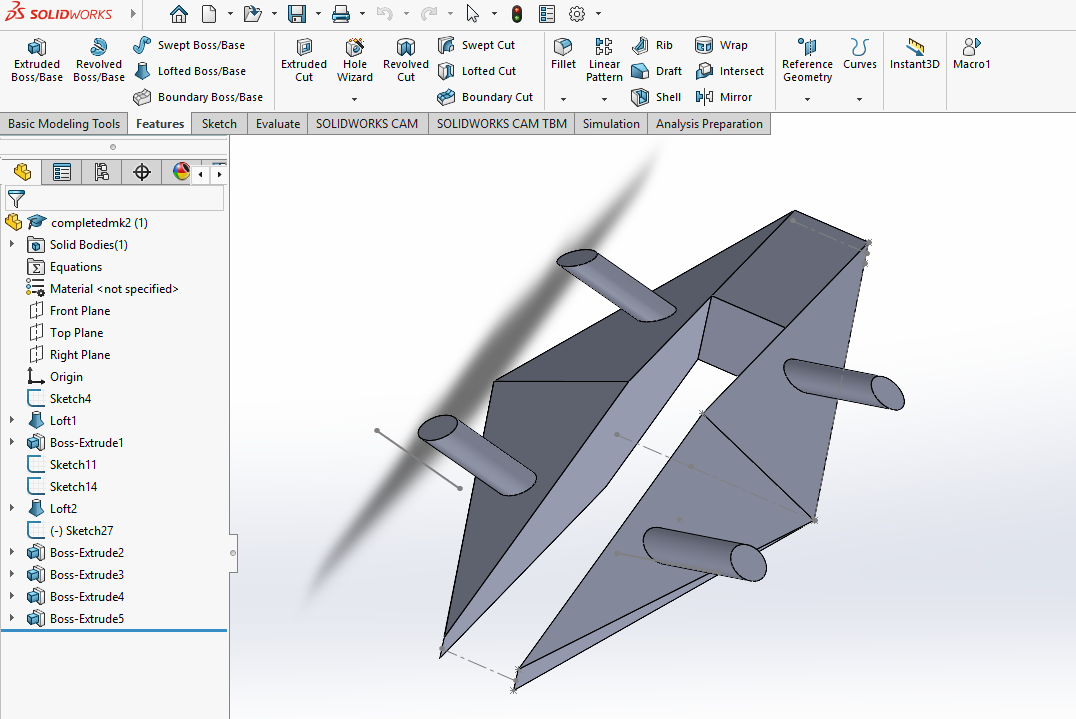
A quadcopter chassis was developed to evaluate a modular and adaptable structural architecture for civilian drone applications. The design utilized a double-hexagonal pyramid geometry integrated with a central cantilever arm system, selected to promote symmetric load distribution while enabling flexible integration of mission-specific components.
The quadcopter configuration was chosen due to its mechanical simplicity, stability, and widespread use in civilian drone systems. The hexagonal pyramid structure provides inherent geometric symmetry, which supports balanced force distribution across the frame. The cantilever arm design allows for extension of motor mounts and payload interfaces without requiring a full structural redesign, thereby enhancing adaptability.
To evaluate modularity, the chassis was developed through multiple design iterations, with each iteration incorporating additional considerations regarding mounting space, moving-part placement, and end-use feasibility for specific operational roles. These features were intended to support integration of diverse payload systems, including environmental sensors, delivery mechanisms, emergency response equipment, and other modular utility attachments.
All chassis prototypes were fabricated using fused deposition modeling (FDM) through the MakerSpace available to University of Wisconsin–Madison students to enable rapid prototyping and iterative refinement. To reduce material consumption and printing time, all models were produced at 25% scale while maintaining geometric fidelity.
Future Plan
If successful, we hope to see changes in federal regulations regarding the industrial use of drone technologies in order to improve efficiency across civilian industries. Currently, the FAA provides strict guidelines limiting drone use outside of heavily regulated industries such as agriculture, and we believe this restricts innovation and exploration of newer solutions to existing inefficiencies.
Sectors such as pest control, large-scale search and rescue (including avalanche rescue), rapid medical device delivery, fire spotting, and firefighting could all benefit from expanded drone integration. Due to existing regulations, innovation within this space is relatively constrained by limitations in testing and operational deployment, leading to continued reliance on older and less efficient methods.
We believe that restricting innovation in emerging technologies is counterproductive. With continued advancement occurring in defense and security drone applications, we hope this project contributes to both cultural and federal changes that encourage similar innovation and adoption within civilian industries.